
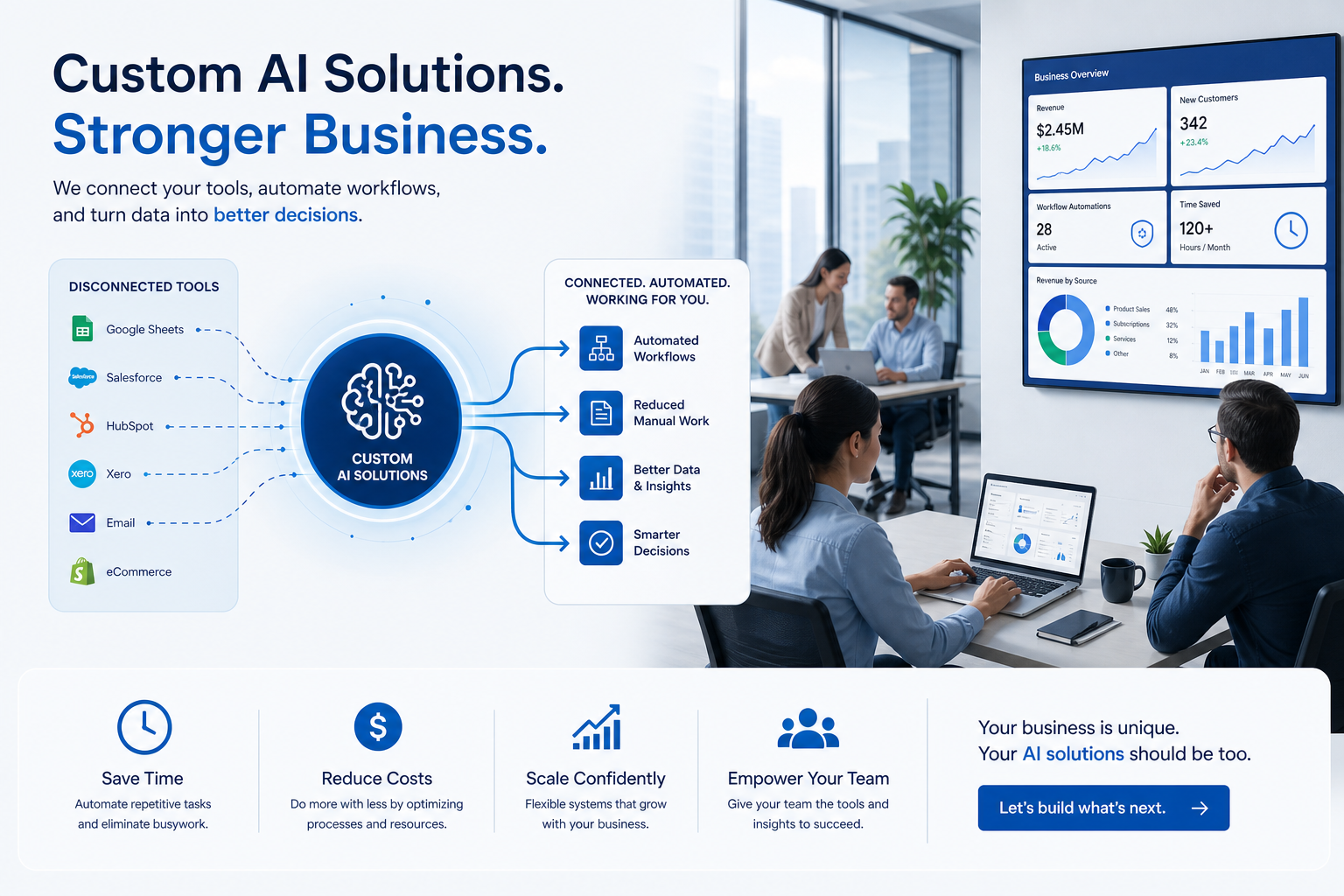
If your team is buried in repetitive tasks, jumping between disconnected tools, and struggling to get clear visibility into what is actually happening across the business, you are not alone. Many small and mid-sized companies know AI could help, but they are overwhelmed by generic platforms, unclear promises, and the fear of creating even more complexity.
That is exactly where custom AI solutions make a difference.
Instead of forcing your business to adapt to a one-size-fits-all tool, custom AI is designed around your workflows, your data, your bottlenecks, and your growth goals. Done right, it can reduce manual busywork, improve reporting, connect systems that do not talk to each other, and help your team make faster, better decisions without requiring a full operational overhaul.
At OneThingSimpler, we approach AI as a practical business improvement tool, not a trend. The goal is simple: identify the highest-friction parts of your operation, simplify them, and build automation and AI around real outcomes.
“65% of organizations utilize generative AI in at least one business function.” – Source
That tells us something important: AI is no longer experimental. But adoption alone does not guarantee value. The businesses seeing the strongest results are not just adding AI randomly. They are applying it to the right processes, in the right way.
“SMBs implementing custom AI solutions have reported ROI between 300% and 700% within 12 to 18 months.” – Source
What custom AI solutions actually are
A custom AI solution is an AI-powered system designed specifically for your business processes, decision-making needs, and existing technology stack.
That can include:
- workflow automation across departments
- AI assistants trained on your internal documents and processes
- custom dashboards and reporting layers
- intelligent routing of customer messages or support tickets
- document extraction and data entry automation
- sales, marketing, and operations insights based on your business data
- internal tools that connect multiple apps and trigger actions automatically
The key difference is this: a custom solution does not start with a software subscription. It starts with a business problem.
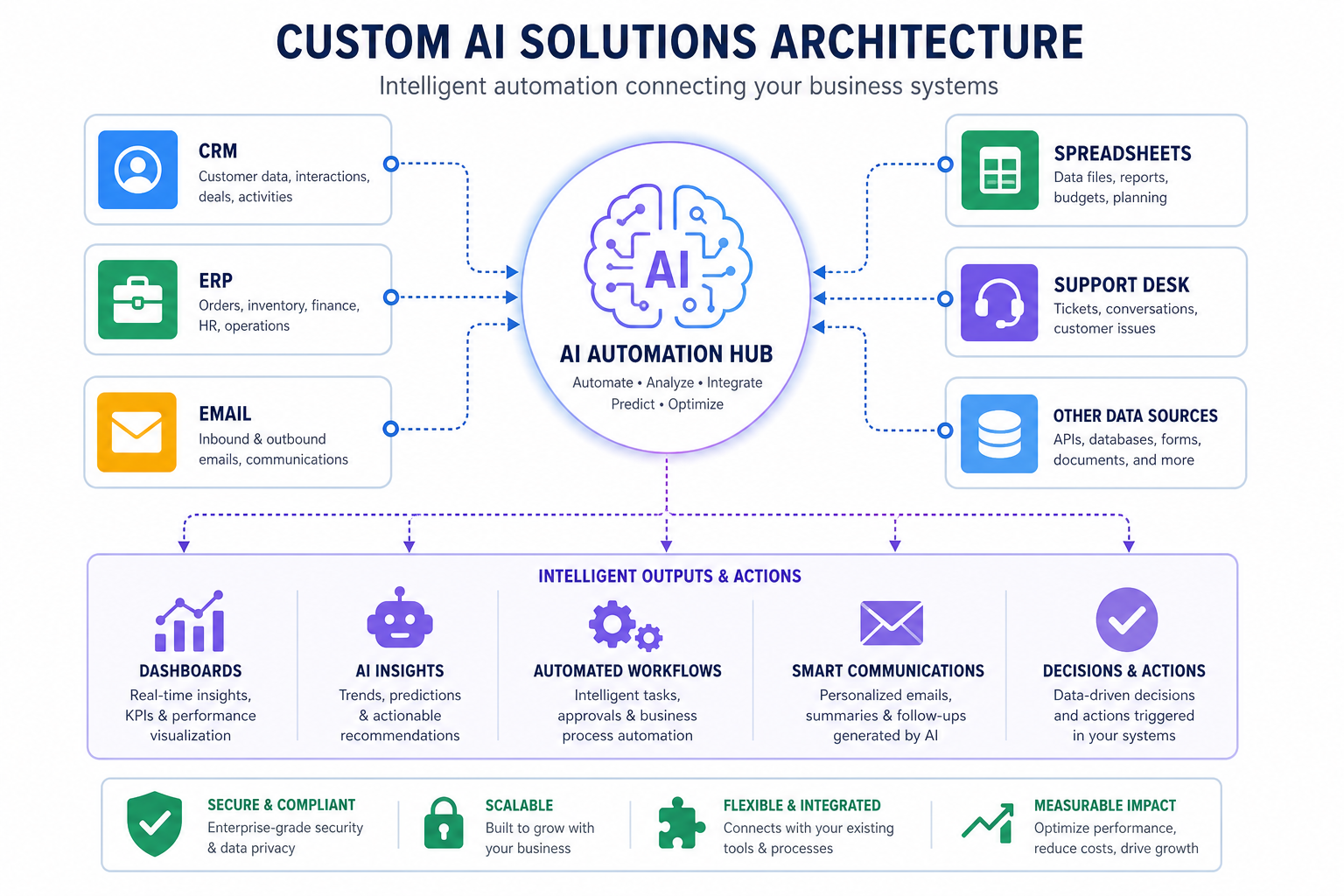
For example, instead of buying three more tools for reporting, lead follow-up, and task management, a custom AI system might:
- pull data from your CRM, inbox, spreadsheets, and project platform
- identify stalled deals or missed handoffs
- summarize next actions for the team
- trigger reminders or automations
- push decision-ready updates into a dashboard
That is not “more software.” That is a smarter operating system for your business.
Why businesses outgrow off-the-shelf AI tools
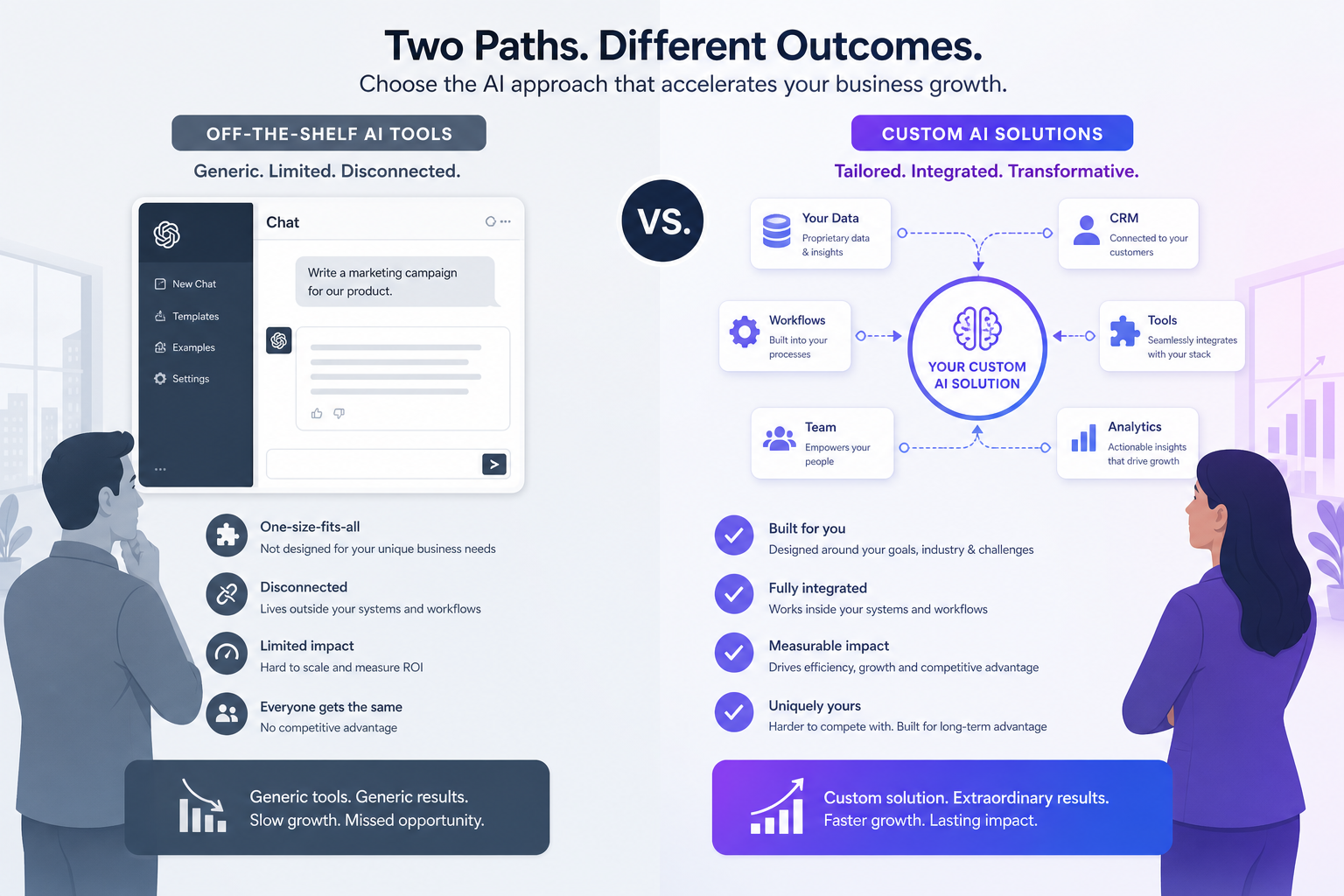
Off-the-shelf AI tools can be useful, especially for experimentation. They are often fast to buy and easy to test. But many companies quickly discover their limits.
Common problems with generic AI tools
- they solve isolated tasks instead of end-to-end workflows
- they do not reflect your internal processes
- they create duplicate work across teams
- they require manual copy-pasting between systems
- they produce output, but not operational follow-through
- they lack the reporting and governance needed for leadership visibility
This is where many competitor articles stop. They explain that custom AI is “tailored” and off-the-shelf is “general.” That is true, but incomplete.
The real business issue is not personalization alone. It is operational fit.
If AI does not fit how work already flows through your business, then your team ends up doing extra work to support the tool. That defeats the purpose.
Custom AI vs off-the-shelf AI: which is right for you?
Here is a practical comparison.
| Factor | Off-the-Shelf AI | Custom AI Solutions |
|---|---|---|
| Setup speed | Fast | Moderate |
| Upfront cost | Lower | Higher initially |
| Long-term fit | Limited | Strong |
| Integration with existing tools | Often partial | Built around your stack |
| Workflow automation depth | Usually shallow | End-to-end |
| Competitive differentiation | Low | High |
| Reporting and visibility | Generic | Tailored to your KPIs |
| Ability to handle unique processes | Weak | Strong |
| Scalability with business complexity | Often poor | Designed for growth |
Choose off-the-shelf AI if:
- you are testing a basic use case
- your workflow is simple and standardized
- speed matters more than precision
- the task is isolated and low risk
Choose custom AI if:
- your team loses time to repetitive, cross-tool work
- you have unique workflows or approval steps
- you need systems to talk to each other
- you want better reporting and operational visibility
- your current tools are underused or fragmented
- you want AI to improve the business, not just produce content
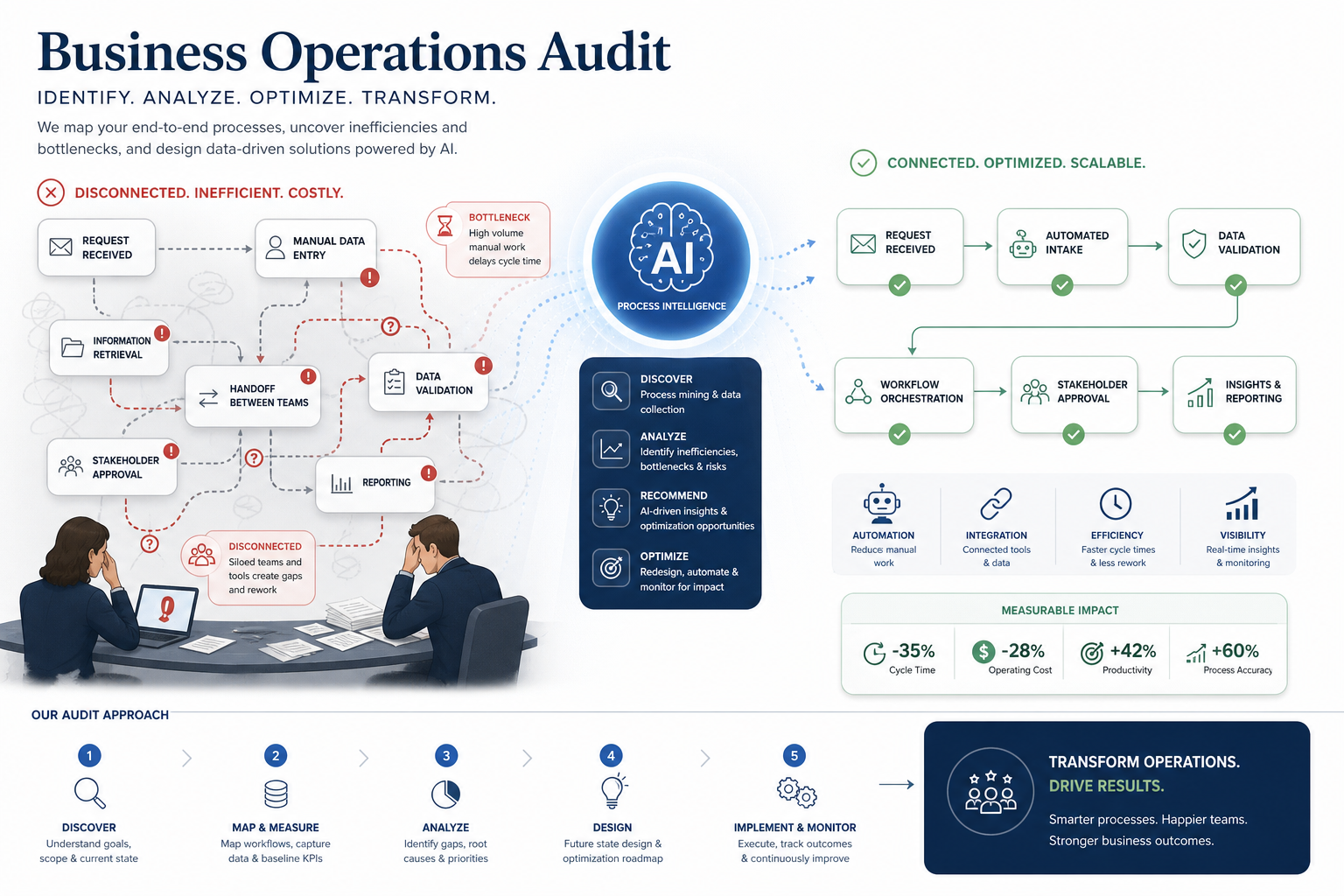
At OneThingSimpler, we often find businesses do not need a complete rebuild. They need a careful audit of what they already use, what is broken between systems, and where custom AI can remove friction without disrupting everything else.
The strongest business case for custom AI: removing operational friction
Most companies do not have a “lack of tools” problem. They have a friction problem.
Work gets delayed because:
- information lives in multiple places
- people manually move data from one system to another
- follow-ups depend on memory
- reporting takes too long to assemble
- leaders lack real-time visibility
- teams create workarounds that eventually become bottlenecks
Custom AI solutions are powerful because they address these hidden inefficiencies directly.
What this looks like in the real world
A custom solution can help:
- turn incoming emails into structured records
- summarize meetings and assign next steps automatically
- detect stalled tasks, approvals, or leads
- combine sales and marketing data into a usable dashboard
- extract information from forms, PDFs, or support requests
- generate internal reports without manual spreadsheet work
- trigger workflows across your CRM, project tools, chat, and email
These changes may sound small in isolation. But together, they can dramatically reduce operational drag.
That is one of the biggest content gaps in competitor articles: they talk about AI as a capability, but not enough about workflow orchestration. For growing businesses, the real value is often not the model itself. It is the system built around it.
Where custom AI creates the biggest impact
Not every process needs AI. The best opportunities are usually where volume, repetition, delays, and decision-making overlap.
Operations
Operations teams often deal with manual handoffs, status updates, exception handling, and process inconsistency.
Custom AI can:
- monitor workflow progress
- identify bottlenecks
- standardize repetitive decisions
- route tasks automatically
- surface exceptions before they become bigger issues
Sales
Sales teams lose momentum when data is incomplete, follow-up is inconsistent, or pipeline reporting is unclear.
Custom AI can:
- enrich lead data
- summarize calls and emails
- prioritize next-best actions
- flag pipeline risks
- automate CRM hygiene and reporting
Marketing
Marketing teams often struggle with scattered performance data and too much manual content coordination.
Custom AI can:
- connect campaign platforms into a unified reporting layer
- generate content drafts based on approved brand inputs
- identify top-performing channels faster
- automate lead handoff logic to sales
- reduce reporting preparation time
Customer support and communication
Support teams need speed, consistency, and context.
Custom AI can:
- classify and route support requests
- draft responses using internal knowledge
- summarize previous interactions
- identify recurring issues
- escalate based on urgency or sentiment
Finance and admin
Back-office functions often contain some of the most automation-friendly work in the company.
Custom AI can:
- process invoices and forms
- reconcile structured data across systems
- identify missing entries or approval delays
- create internal summaries for leadership
- reduce repetitive admin effort
The hidden advantage: better use of your current tool stack
A lot of businesses assume they need brand-new platforms to modernize. Usually, they do not.
In many cases, the better move is to get more value from the tools already in place.
That is one of the clearest advantages of the OneThingSimpler approach. Before recommending new AI systems, we look at:
- what tools you already pay for
- where data gets stuck
- where people duplicate work
- which reports require manual assembly
- which bottlenecks are process issues versus tool issues
- where AI can connect the gaps
This matters because replacing core systems is expensive, disruptive, and often unnecessary. A smart custom AI layer can often sit between your existing tools and make them work better together.
The custom AI decision framework
Before investing in a custom build, ask these questions.
1. Is the problem repetitive and costly?
If a task happens frequently and burns team time, it is a strong candidate.
2. Does the work span multiple tools or teams?
The more handoffs and system-switching involved, the more likely custom AI will help.
3. Is the process important enough to optimize properly?
Custom AI makes the most sense when the process affects revenue, speed, customer experience, or leadership visibility.
4. Are generic tools forcing workarounds?
If your team is still relying on manual patches, there is likely a fit issue.
5. Do you need the solution to evolve with the business?
Custom systems are especially valuable when your processes, reporting needs, and scale will change over time.
What a smart custom AI engagement should include
Many businesses make the mistake of jumping straight into “build mode.” That is risky.
A strong custom AI project should begin with clarity.
A better process looks like this
| Phase | What happens | Why it matters |
|---|---|---|
| Audit | Review workflows, tools, data, and pain points | Prevents solving the wrong problem |
| Prioritization | Rank use cases by value, complexity, and speed to impact | Focuses effort on quick wins and strategic value |
| Solution design | Map systems, automations, AI functions, and reporting needs | Creates a practical blueprint |
| Implementation | Build integrations, automations, AI layers, and dashboards | Turns strategy into a working system |
| Testing and refinement | Validate outputs, reduce errors, improve fit | Ensures adoption and reliability |
| Ongoing optimization | Measure performance and expand carefully | Keeps value growing over time |
This audit-first model is a major differentiator. Competitor content often jumps from “AI is important” to “here are some tools.” What is missing is the operational diagnosis in between.
That is exactly why OneThingSimpler emphasizes AI and tool stack audits. You get a clearer understanding of what is actually slowing the business down before investing in automation or custom development.
What competitors usually miss about custom AI solutions
After reviewing leading articles on this topic, several common themes show up again and again:
- custom AI is tailored
- off-the-shelf AI is faster to deploy
- generative AI, ML, NLP, and computer vision are important
- AI can automate and improve decision-making
All true. But several important content gaps remain.
Content gap 1: most articles do not explain how custom AI fits into messy real operations
Real businesses do not run on neat diagrams. They run on legacy processes, spreadsheets, inboxes, Slack threads, missed updates, and partial data. A practical guide needs to address that reality.
Content gap 2: they over-focus on technology and under-focus on process design
A poorly designed workflow with AI added on top is still a poorly designed workflow. Process simplification matters first.
Content gap 3: they talk about “ROI” broadly without showing where the returns actually come from
The biggest returns often come from:
- reduced labor hours
- fewer delays and missed handoffs
- cleaner data
- faster decisions
- better use of existing tools
- improved manager visibility
Content gap 4: they rarely discuss internal adoption
If your team does not trust or use the system, the project stalls. Good custom AI is not only accurate. It is usable, transparent, and embedded into normal work.
Content gap 5: they frame the decision as build vs buy, when many businesses need connect + optimize + automate
For many SMBs, the smartest answer is not “build a giant AI platform.” It is:
- audit the stack
- simplify the process
- connect the systems
- automate the repetitive work
- add AI where judgment, summarization, prediction, or classification creates leverage
That is the practical middle path OneThingSimpler is built around.
The risks of custom AI and how to avoid them
Custom AI can create real value, but only if it is approached carefully.
Common risks
- automating a broken process
- overbuilding too early
- unclear ownership
- poor data quality
- disconnected implementation from daily team workflows
- chasing trendy use cases with weak business value
How to avoid them
- start with a business problem, not a model
- target one or two high-friction workflows first
- use measurable success metrics
- build around current operations
- involve the people who actually do the work
- focus on usability and reporting, not just output quality
This is another reason a simplification-led approach matters. The best AI consulting is not about making the system more impressive. It is about making the business easier to run.
Signs your business is ready for custom AI
You do not need a giant enterprise budget to benefit from custom AI. But you do need the right signals.
Your business may be ready if:
- your team spends hours each week on repetitive admin
- your tools do not share information reliably
- reporting is slow, manual, or incomplete
- customer communication gets delayed or inconsistent
- leadership lacks clarity on operational performance
- growth is adding complexity faster than your team can absorb it
- off-the-shelf tools have helped, but only partially
If that sounds familiar, custom AI does not have to mean a massive transformation. Often, the best first step is identifying the one operational bottleneck that is quietly costing the most time and momentum.
Examples of high-value custom AI use cases
Here are practical examples that align closely with what growth-stage businesses need.
AI-powered internal operations assistant
A custom assistant connected to your SOPs, tools, and internal data can help staff find answers, complete recurring tasks, and reduce interruptions.
Automated lead qualification and follow-up orchestration
Instead of manually sorting inquiries and assigning follow-ups, AI can classify leads, pull context from your systems, and trigger the right next step.
Unified reporting and decision dashboard
A custom reporting layer can combine data from marketing, sales, finance, and operations into dashboards leadership can actually use.
Workflow bottleneck detection
AI can analyze timestamps, status changes, queues, and handoffs to identify where work consistently slows down.
Smart document and form processing
Invoices, applications, requests, onboarding forms, and support documents can be read, categorized, and pushed into the right systems automatically.
These types of use cases are where OneThingSimpler creates the most value: not by adding more noise, but by removing friction and making the business easier to scale.
How to measure whether a custom AI solution is working
A strong AI project should improve more than just speed. It should improve operational quality.
Useful KPIs to track
| Area | KPI examples |
|---|---|
| Efficiency | Hours saved, tasks automated, cycle time reduction |
| Cost | Labor cost reduction, lower rework, fewer manual interventions |
| Quality | Error reduction, improved consistency, fewer missed handoffs |
| Visibility | Faster reporting, better dashboard accuracy, improved manager insight |
| Growth | More capacity without added headcount, faster customer response, higher throughput |
If you cannot define what success looks like before implementation, that is a sign to pause and audit first.
The best custom AI strategy for SMBs
For most small and mid-sized businesses, the right strategy is not to build everything at once.
A better sequence is:
- identify friction-heavy workflows
- audit the current tool stack
- simplify the process
- connect systems
- automate repetitive steps
- layer in AI where it improves judgment, speed, or insight
- expand gradually based on results
This is how businesses avoid wasted spend and build internal confidence. Small wins compound. Once a team sees that AI can remove real busywork and improve decisions, adoption becomes much easier.
Why OneThingSimpler is the right partner for custom AI solutions
There are plenty of firms that can talk about AI. Fewer can make it practical.
OneThingSimpler is built for businesses that want meaningful improvement without unnecessary disruption. That means focusing on:
- reducing manual busywork and repetitive tasks
- saving time and operational costs
- improving the use of your existing tool stack
- identifying inefficiencies and bottlenecks through audits
- connecting disconnected tools and systems
- delivering custom AI solutions tailored to real business needs
- automating workflows for smoother operations
- supporting better reporting, dashboards, and decision-making
- enabling strategic growth without requiring a full business overhaul
That is a fundamentally different promise from “let’s add AI to everything.”
It is a smarter, more grounded approach: simplify first, automate second, scale with confidence.
Final thoughts
Custom AI solutions are not just for giant enterprises with huge engineering teams. They are increasingly the most practical path for businesses that have reached the limits of disconnected tools, manual coordination, and generic automation.
If your business is feeling the strain of repetitive work, unclear reporting, and systems that do not work well together, custom AI may be less about innovation and more about relief. Relief for your team. Relief for your operations. Relief for leadership trying to make decisions without a clean picture of what is happening.
The best custom AI solutions do not add complexity. They remove it.
If you want to see where AI and automation can create the biggest gains in your business, OneThingSimpler can help you find the bottlenecks, connect the gaps, and build a practical path forward.
Ready to simplify your operations and make AI actually useful? Start with OneThingSimpler and turn busywork, disconnected tools, and workflow friction into a system built for smarter growth.